 ☕️
☕️Liliaokeawawa (Lily) Cothren
👋 Hi, there! I’m Lily Cothren, a Ph.D. student in the Department of Electrical, Computer, and Energy Engineering at the University of Colorado, Boulder under the supervision of Professor Liz Bradley and Professor Raissa D’Souza. I’m excited to continue my research as a Fellow for the National Science Foundation Graduate Research Fellowship Program (NSF GRFP) that started in the fall of 2023.
Check out my CV and projects below!
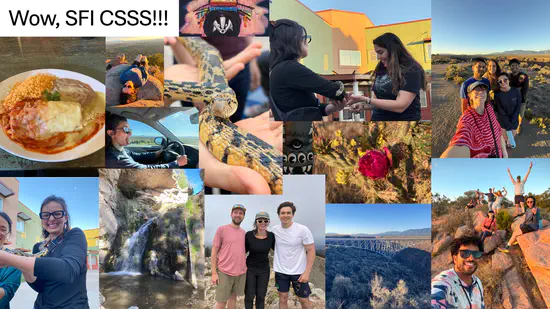
Santa Fe Institute Complex Systems Summer School 2026
The program helped me to develop a better understanding of the methods used to analyze and predict behaviors of complex systems and offer instruction on the latest applications of the salient theories. The program hosted a number of invited speakers that I was excited to hear from, as their work is related to my interests in understanding how couplings between sub-components of a system can drive interesting behaviors. I was particularly excited to hear from Professor Fernanda Valdovinos since her research on how ecological networks respond and adapt to human influences relates to my goal of studying how coupled catastrophes can be controlled (via specially designed input signals, which can model human influence). I loved learning from Professor Brandon Ogbunu about how sub-components can interact in surprising ways in social settings and institutions; his talk moved me. This summer school afforded me the chance to contribute in meaningful ways with new collaborators and to gain new tools for my own research goals. Outside of reguar lectures and discussions, we also worked on projects. For these, I chose to join groups that were studying topics completely out of my comfort zone (when else will I get the opportunity to work with so many wonderful experts in these interesting areas?). I was fortunate enough to be a part of two projects. One considered how a network of LLMs handles a question if each agent in the network can access what their neighbors answer. For this, the goal was to observe emergent behaviors amongst the opinions, and to ask whether topology influences these results. My other project considered what explore/exploit means in a cognitive sense. Can we quantitatively identify the goal state? Can this be extended to situations where, say, the goal is to get people to open up beyond their preconceived notions?
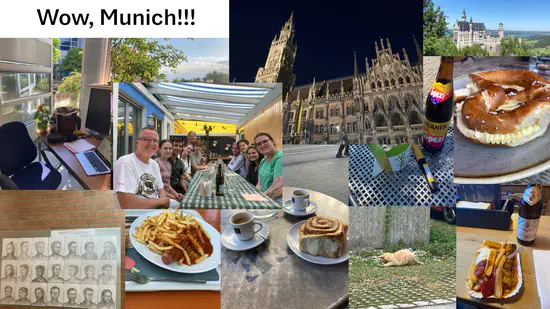
Scholarly Visit to the Technical University of Munich
This visit to Professor Katharina Krischer’s group was invigorating and refreshing! I visited her group for two weeks in May 2026 shortly after passing my comprehensive exam. I was grateful for the interest in my recent project on coupled catastrophes (and control thereof) and was able to collaborate with several members of her group. Through these discussions, I learned about the AUTO bifurcation software program. AUTO is a widely used, open-source software program for solving continuation and bifurcation problems in ordinary differential equations (ODEs) and algebraic systems. However, it has a steep learning curve. Although I spent most of my time learning how to use this software, I also learned that Professor Krischer’s students work together on problems. That is, instead of having totally independent research projects, they share approaches using experiments, theory, and numerical simulations.
Online Feedback Optimization and Singular Perturbation via Contraction Theory
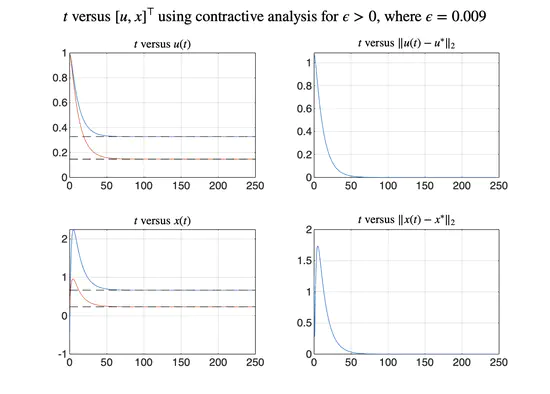
In this paper, we provide a novel contraction-theoretic approach to analyze two-time scale systems, including those commonly encountered in online feedback optimization (OFO). Our framework endows these systems with several robustness properties, enabling a more comprehensive characterization of their behaviors. The primary assumptions are the contractivity of the fast subsystem and the reduced model, along with an explicit upper bound on the time-scale parameter. For two-time scale systems subject to disturbances, we show that the distance between solutions of the nominal system and solutions of its reduced model is uniformly upper bounded by a function of contraction rates, Lipschitz constants, the time-scale parameter, and the variability of the disturbances over time. Applying these general results to the OFO context, we establish new individual tracking error bounds, showing that solutions converge to their time-varying optimizer, provided the plant and steady-state feedback controller exhibit contractivity and the controller gain is suitably bounded. Finally, we explore two special cases – for autonomous nonlinear systems, we derive sharper bounds than those in the general results, and for linear time-invariant systems, we present novel bounds based on induced matrix norms and induced matrix log norms.
Coupled catastrophes in systems with bidirectional feedback
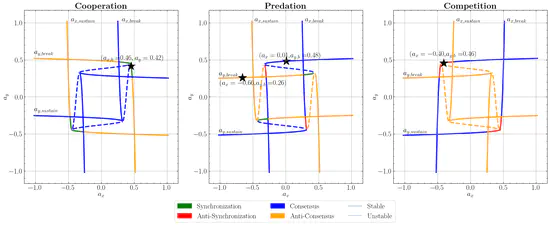
Catastrophes are present across many disciplines, ranging from the extinction of populations in ecosystems to the collapse of prices in financial systems. Here, we focus on how interactions between systems influence these catastrophes. Specifically, we study two bidirectionally coupled sub-systems—each of which possesses an S-shaped bifurcation curve with saddle-node bifurcations—and explore how interactions between them can lead to simultaneous bifurcations. There are four types of such coupled catastrophes – synchronization, anti-synchronization, consensus, and anti-consensus. Which of these behaviors manifests depends both the intrinsic dynamics of the subsystems and ways in which they are coupled. In general, there are three possible coupling classes – cooperation, competition, and predation. We develop an analytic/graphical methodology to determine and visualize the locus of the coupled catastrophes in parameter space, and we show which classes of couplings support different types of coupled catastrophes. Finally, we discuss several potential applications areas from distinct domains.
Online Regulation of Dynamical Systems to Solutions of Constrained Optimization Problems
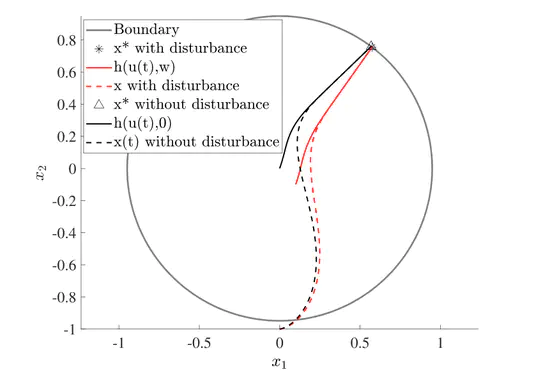
This paper considers the problem of regulating a dynamical system to equilibria that are defined as solutions of an input- and state-constrained optimization problem. To solve this regulation task, we design a state feedback controller based on a continuous approximation of the projected gradient flow. We first show that the equilibria of the interconnection between the plant and the proposed controller correspond to critical points of the constrained optimization problem. We then derive sufficient conditions to ensure that, for the closed-loop system, isolated locally optimal solutions of the optimization problem are locally exponentially stable and show that input constraints are satisfied at all times by identifying an appropriate forward-invariant set.
Data-enabled Gradient Flow as Feedback Controller - Regulation of Linear Dynamical Systems to Minimizers of Unknown Functions
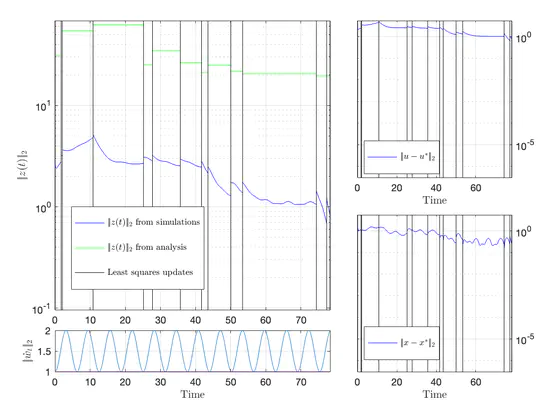
This paper considers the problem of regulating a linear dynamical system subject to external disturbances to the solution of a convex optimization problem with an unknown or partially-known cost. Our results demonstrate exponential input-to-state stability of the closed-loop system with our gradient-flow based controller.
Online Optimization of Linear Time Invariant Dynamical Systems with Cost Perception
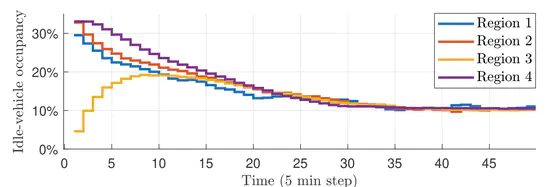
This paper considers the problem of regulating a discrete-time linear time-invariant (LTI) system to solution trajectories of a convex optimization problem, with an unknown cost. We propose a data-driven, gradient-based feedback controller that uses estimates of the cost functions obtained by a trained neural network to control the LTI system. We identify sufficient conditions to guarantee exponential input-to-state stability (ISS) of the closed loop system with respect to errors due to disturbances, temporal variability of the cost functions, and the need to use estimated costs from a neural network. Finally, we provide an illustrative numerical example in the context of online ride-share scheduling.
Perception-based Sampled-data Optimization of Dynamical Systems
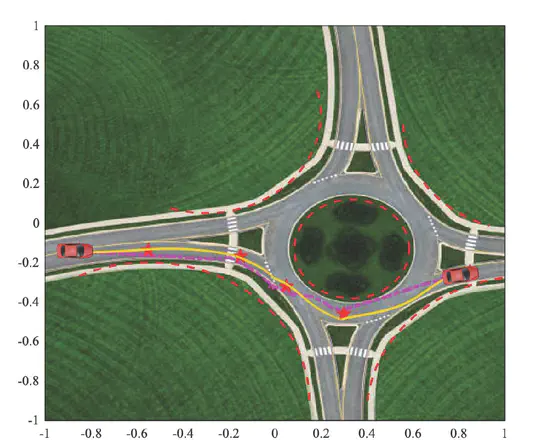
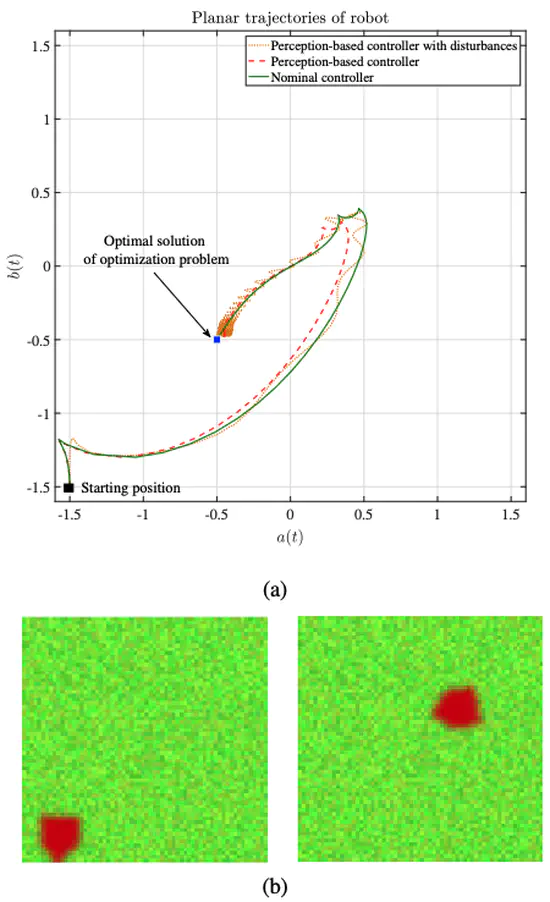
Motivated by perception-based control problems in autonomous systems, this paper addresses the problem of developing feedback controllers to regulate the inputs and the states of a dynamical system to optimal solutions of an optimization problem when one has no access to exact measurements of the system states. In particular, we consider the case where the states need to be estimated from high-dimensional sensory data received only at discrete time intervals. We develop a sampled-data feedback controller that is based on adaptations of a projected gradient descent method, and that includes neural networks as integral components to estimate the state of the system from perceptual information. We derive sufficient conditions to guarantee (local) input-to-state stability of the control loop. Moreover, we show that the interconnected system tracks the solution trajectory of the underlying optimization problem up to an error that depends on the approximation errors of the neural network and on the time-variability of the optimization problem; the latter originates from time-varying safety and performance objectives, input constraints, and unknown disturbances. As a representative application, we illustrate our results with numerical simulations for vision-based autonomous driving.
Online Optimization of Dynamical Systems with Deep Learning Perception
This paper considers the problem of regulating a nonlinear dynamical system whose state cannot be directly measured. Leveraging neural networks to approximate system states, we demonstrate input to state stability of the closed-loop of the dynamical system and our data-driven controller.