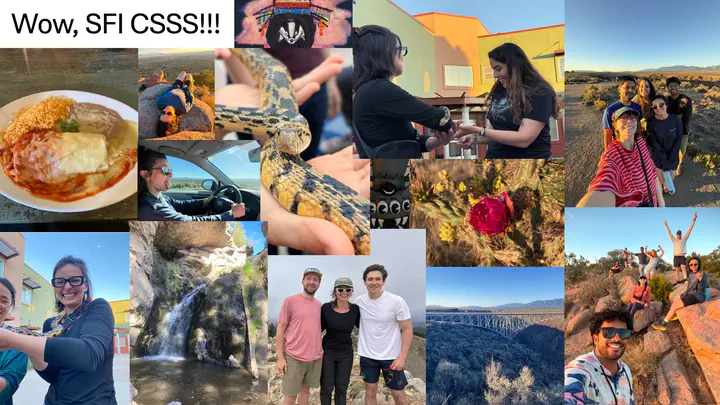
 Some great memories at the summer school.
TThe program helped me to develop a better understanding of the methods used to analyze and predict behaviors of complex systems and offer instruction on the latest applications of the salient theories. The program hosted a number of invited speakers that I was excited to hear from, as their work is related to my interests in understanding how couplings between sub-components of a system can drive interesting behaviors. I was particularly excited to hear from Professor Fernanda Valdovinos since her research on how ecological networks respond and adapt to human influences relates to my goal of studying how coupled catastrophes can be controlled (via specially designed input signals, which can model human influence). I loved learning from Professor Brandon Ogbunu about how sub-components can interact in surprising ways in social settings and institutions; his talk moved me. This summer school afforded me the chance to contribute in meaningful ways with new collaborators and to gain new tools for my own research goals. Outside of reguar lectures and discussions, we also worked on projects. For these, I chose to join groups that were studying topics completely out of my comfort zone (when else will I get the opportunity to work with so many wonderful experts in these interesting areas?). I was fortunate enough to be a part of two projects. One considered how a network of LLMs handles a question if each agent in the network can access what their neighbors answer. For this, the goal was to observe emergent behaviors amongst the opinions, and to ask whether topology influences these results. My other project considered what explore/exploit means in a cognitive sense. Can we quantitatively identify the goal state? Can this be extended to situations where, say, the goal is to get people to open up beyond their preconceived notions?
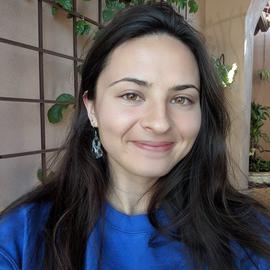
Liliaokeawawa (Lily) Cothren
My research interests include control theory, catastrophe theory, and nonlinear dynamics.